Sam Hughes · 20 October 2026
Privacy Legislation Evolutions and Sustainability Initiatives in Media Network Development
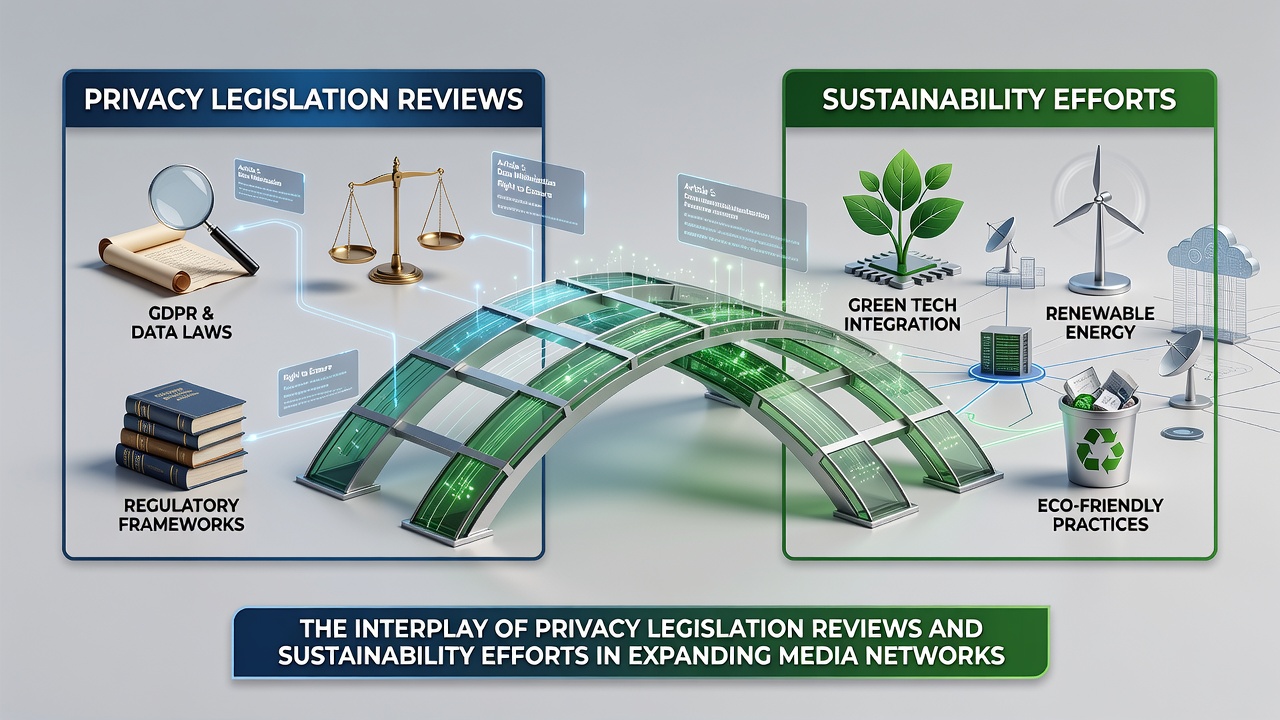
Privacy legislation reviews continue to intersect with sustainability initiatives as media networks expand their digital footprints, and observers note that these two areas often share overlapping demands on data handling and resource allocation. In October 2026, several jurisdictions plan updates to existing frameworks that will require media organizations to reassess both compliance protocols and environmental targets simultaneously.
Current Privacy Framework Adjustments
Regulatory bodies across different regions have scheduled evaluations that focus on data minimization, cross-border transfers, and consent mechanisms, while media outlets must adapt storage practices to meet new standards. The European Commission maintains ongoing guidance on data protection rules that affect how networks archive user information, and similar processes unfold in Canada where federal privacy laws receive periodic scrutiny from the Office of the Privacy Commissioner. These reviews often highlight the energy costs tied to prolonged data retention, which directly connects to sustainability metrics that media companies track through carbon accounting systems.
Sustainability Measures in Network Expansion
Media organizations pursue lower emissions through renewable-powered servers and optimized content delivery networks, and research from institutions such as the University of Oxford's Reuters Institute indicates that digital infrastructure accounts for a growing share of operational footprints. Expanding networks adopt practices like edge computing to reduce transmission distances, yet these choices must align with privacy rules that limit certain data localization options. Reports from the Australian Department of Climate Change, Energy, the Environment and Water document how media entities in the Asia-Pacific region integrate green procurement policies with regulatory reporting requirements.
Points of Intersection
Legislative reviews frequently examine the environmental implications of data processing requirements, and this creates situations where compliance upgrades coincide with efficiency upgrades. For instance, when privacy rules tighten around data portability, media networks evaluate whether new transfer protocols increase server loads or encourage more streamlined architectures that consume less power. One study from academic researchers at Stanford University examined how consent management platforms influence overall energy use in content distribution, revealing measurable overlaps between the two domains. Expanding networks therefore coordinate legal teams with sustainability officers to avoid conflicting implementations, and this coordination becomes more pronounced as global reach increases.

What's notable is that some jurisdictions now include environmental impact assessments within privacy consultations, which means media operators submit joint documentation covering both areas. Data from industry reports shows that networks operating across multiple continents face layered obligations that reward unified strategies rather than separate initiatives. Those who've tracked these developments observe that shared metrics, such as data volume per user session, serve dual purposes in regulatory filings and emissions calculations.
Effects on Growing Media Operations
As networks scale, the interplay influences decisions around cloud partnerships and content archiving policies, and organizations weigh the benefits of regional data centers against both privacy transfer rules and renewable energy availability. In practice, this leads to phased rollouts where privacy-compliant architectures incorporate energy-efficient hardware from the outset. External analyses from sources like the International Telecommunication Union highlight that media growth in emerging markets often coincides with newer privacy statutes, creating opportunities to embed sustainability features during initial builds rather than retrofits.
Training programs for reporters and technical staff now incorporate modules on these combined requirements, and partnerships between Nordic media groups demonstrate how shared resources help smaller outlets meet standards that would otherwise strain individual budgets. The reality is that legislative timelines, including those slated for October 2026, push networks to model scenarios that project both compliance costs and carbon reductions over five-year periods.
Conclusion
Media networks continue to navigate the combined pressures of privacy legislation reviews and sustainability efforts through integrated planning that treats data governance and environmental performance as connected operational factors. Evidence from regulatory updates and industry measurements indicates that this approach supports scalable growth while satisfying requirements across regions. Those managing expansion therefore monitor legislative calendars and emissions benchmarks in tandem to maintain consistent progress on both fronts.